
As democracy across Europe faces growing challenges – from rising political polarisation, the spread of disinformation and declining trust in institutions to increasing pressure and even attacks on civil society – strengthening democracy is more important than ever.
INCITE-DEM brings to the European Parliament insights from more than ten EU Member States and presents research-based roadmaps for a more resilient, responsive, and legitimate European democracy.

Democratic innovations are essential for strengthening societal resilience and preserving Europe’s unity. The findings of INCITE-DEM remind us that participation must lead to real influence.
Matjaž Nemec, co-host and member of the European Parliament (S&D)
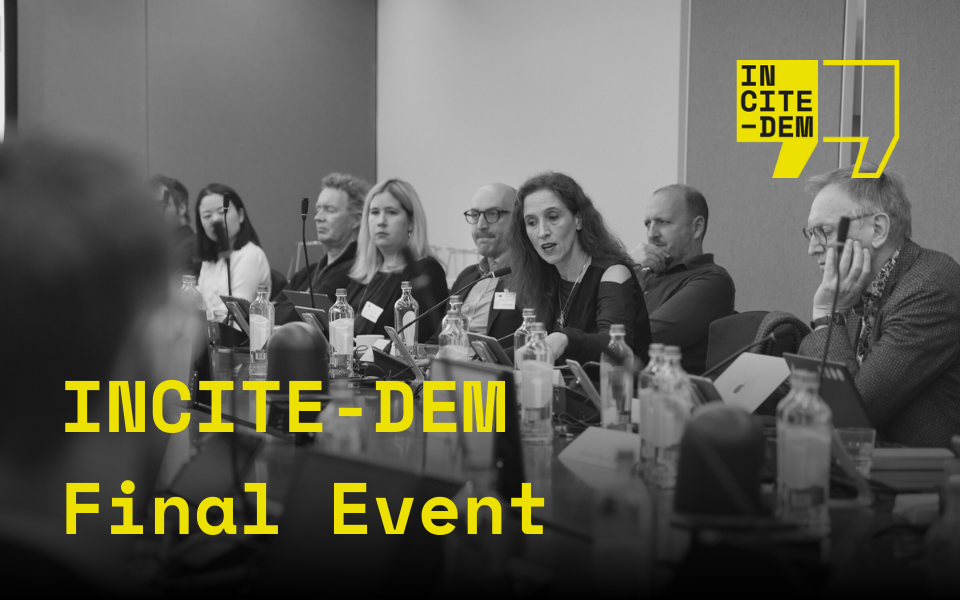
The final INCITE-DEM conference Shaping the Future of Democracy took place at the European Parliament in Brussels, bringing together Members of the European Parliament and European Commission, as well as experts, academics, and civil society representatives to discuss a crucial question: how can democratic systems remain legitimate, inclusive, and effective in an era of polarisation, disinformation, and mistrust?
At a time when European institutions are reassessing their approaches to citizen engagement, INCITE- DEM offered timely research-based guidance on how participatory and deliberative mechanisms can meaningfully complement representative democracy. Research from the project shows that Europe’s democracy does not suffer from citizen apathy, but rather from low-impact participation – processes in which citizens engage, but rarely see how their input shapes decisions. This gap between participation and impact fuels frustration and erodes trust in democratic institutions.

Democracy strengthens itself when citizens do more than vote. Through shared responsibility and active citizenship, people protect democratic values and ensure that power remains accountable, inclusive, and rooted in the lived realities of society.
Ana Catarina Mendes, Member of the European Parliament and S&D Vice-President for the Rule of Law and Strong Democracy
The INCITE-DEM findings are based on 24 research events conducted in nine European countries, engaging more than 560 participants from among citizens, policymakers, civil society organisations, and other stakeholders.
At the same time, INCITE-DEM finds that the future of democratic participation lies in institutionalised, inclusive, and hybrid approaches. Democratic innovations such as citizens’ assemblies are most effective when they are permanent, properly resourced, and formally embedded in policymaking. Participation must move beyond consultation towards real influence, supported by targeted inclusion measures and hybrid digital-offline formats. When designed this way, participatory democracy can strengthen legitimacy, reduce polarisation, and help European institutions respond more effectively to citizens’ concerns.
From a research perspective, the discussions highlighted the urgency of democratic innovation in the face of intersecting social and ecological crises:

Democratic innovations are urgently needed to enable societies to navigate the parallel social and ecological sustainability crises in an increasingly polarized and conflictual (geo)political setting against the interests of those benefitting from the unsustainability and injustice of the current system. Incite-DEM shows that citizens envision and desire fair, inclusive, transparent, and impactful participatory formats enabling the societal pursuit of collective rather than privatized benefits.
Doris Fuchs, Director at the Research Institute for Sustainability (RIFS) and Professor at the University of Münster
The conference concluded with a strong call to translate research findings into concrete policy action, such as the establishment of permanent citizen assemblies, the introduction of a so-called “democratic allowance” to ensure inclusivity, or the expansion of European consultation processes into physical spaces across the block. The INCITE-DEM roadmaps offer a cohesive blueprint for strengthening democratic participation at EU and national levels, supporting institutions in designing participatory processes that are meaningful, inclusive, and responsive to citizens’ concerns.

Navigating our current ecological and social crises requires a departure from safe, incrementalist approaches in favor of bold civic interventions. The INCITE-DEM project underscores that citizens desire impactful, transparent formats that challenge the current system’s injustices.”
Francesc Cots, Energy and Climate Manager at eco-union and Professor at Universitat Oberta de Catalunya
Policy-makers, academic partners and civil society emphasised that democratic innovations are not a replacement for representative democracy, but a necessary complement to restore trust, legitimacy, and long-term societal resilience.
Discover more insights with the Roundtable discussion held at the final event: