On 27 November, the Barcelona Policy Dialogue Session, organized by eco-union as part of a series of nine policy sessions they are coordinating across Europe, brought together more than 20 participants from public administrations, civil society organisations, trade unions, companies and engaged citizens. The goal was to reflect on and refine the nine policy recommendations on democratic innovation—proposals derived from a comprehensive Roadmap structured around four fundamental pillars: Strengthening the foundations of participation, Moving democratic innovations to the mainstream, Harnessing technology to bridge divides, and Rebuilding social cohesion—developed and co-designed by citizens across Europe.
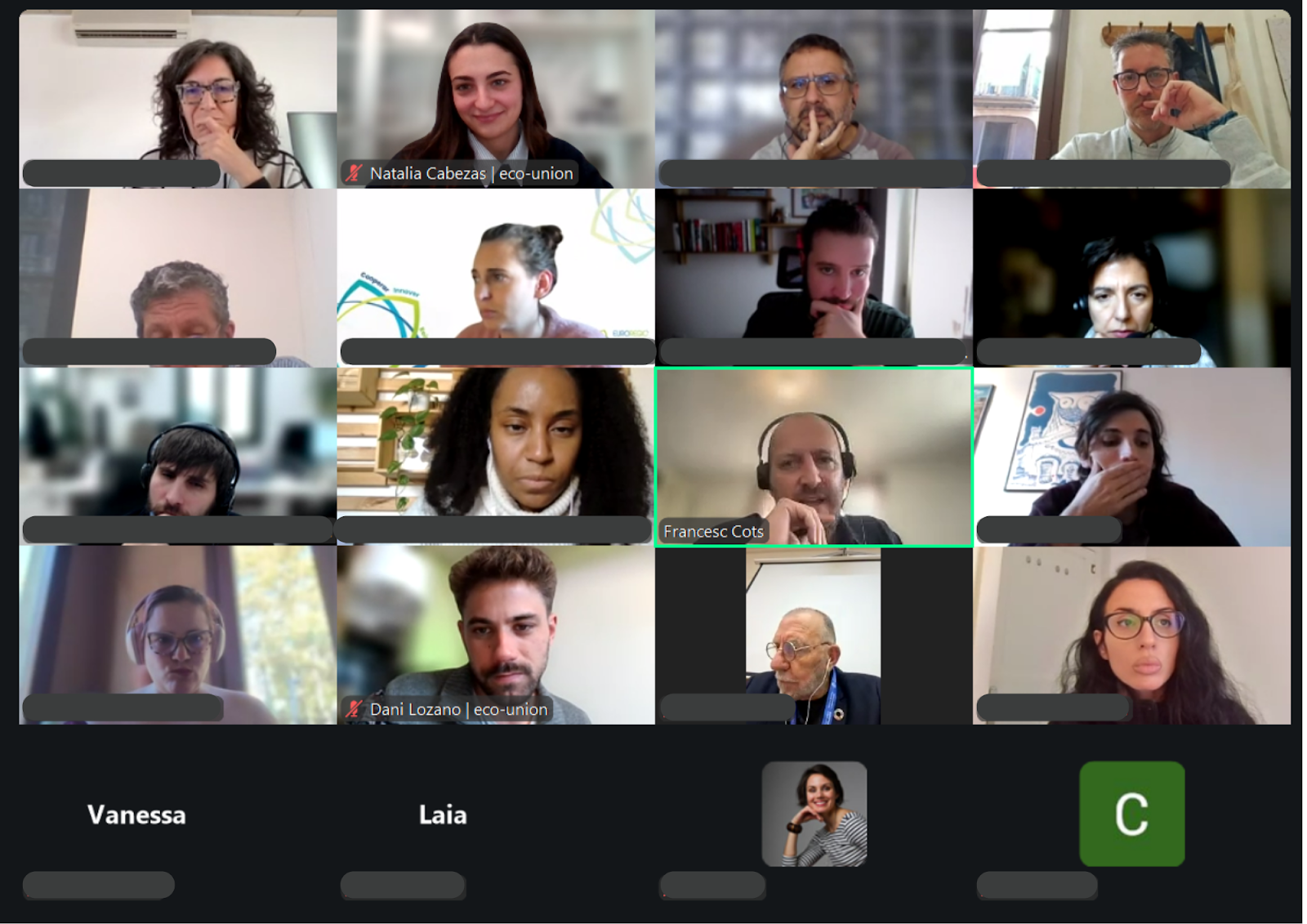
The event, held online via Zoom, gathered a diverse mix of profiles with expertise in public participation, governance, innovation, digitalisation and social inclusion. This diversity enabled a rich exchange of perspectives throughout the discussions.
From ideas to refinement: a collaborative dialogue
The objective of the session was to evaluate and improve the policy recommendations emerging from the project’s Democracy Labs and Interactive Fora held across nine European countries. After a brief introduction to INCITE-DEM and the purpose of the dialogue, participants worked in three parallel breakout groups.
Each group explored the following dimensions for several recommendations:
- Benefits: What added value could this recommendation bring to democratic practice?
- Risks and resources: What barriers, risks or limitations might hinder implementation? What resources would be required?
- Refinements: What adjustments, clarifications or improvements could strengthen the recommendation?
The discussions were active, respectful and highly engaged, with participants providing thoughtful reflections rooted in their practical experiences.
Key insights from group deliberations
Across the three breakout groups, several cross-cutting themes emerged:
- Practical feasibility matters
Participants emphasised that even well-designed democratic innovations require realistic implementation pathways, sufficient resources and clear assignment of responsibilities. Without institutional buy-in, impact may be limited.
- Clarity and accessibility of recommendations
Some formulations were perceived as abstract or technical. Clearer definitions and simpler language were seen as essential to support uptake by policymakers and practitioners.
- Inclusion must be intentionally designed
Participants highlighted the need to address inequalities in participation, including digital divides, cognitive accessibility, gender balance and territorial disparities. Ensuring that vulnerable or underrepresented groups can meaningfully engage remains a core challenge.
- Tools, incentives and feedback loops
Digital tools were viewed as promising but also raised questions about data governance and accessibility for non-digital audiences. Participants also stressed the importance of transparent feedback loops to maintain trust and motivation in participation processes.
Overall, the group brought a strong sense of institutional realism—pointing out political, legal and administrative constraints—while also identifying opportunities and creative pathways to strengthen the recommendations.